


PART F of the BUILDING REGULATIONS 2022

The new Part F Volume 1 of the Building Regulations has just come into force (15th June 2022) and covers Dwellings in England and the general aim “is to protect the health of occupants of the building by providing adequate ventilation.”
The main thrust of these regulations appears to be steering people away from natural ventilation with extract fans, although they are considered an acceptable method.
The new Part F introduces some new features, these include:
- Every new home to be tested.
- Noise: any ventilation system should not be any noisier than 30dB in bedrooms, although testing is not required.
- Passive stack ventilation (System 2) has vanished.
- Trickle vent areas have increased in size in many cases.
- Minimum flow rates based on the number of bedrooms has increased.
- More explicit that any ventilation system should be tested/ commissioned.
- Natural ventilation with trickle vents is not appropriate for any dwelling where the design air permeability less than 5m3/m2/hr@50Pa or the actual air permeability is less than 3m3/m2/hr@50Pa. If this occurs, then “a continuous mechanical extract ventilation system should be installed”.
- Pollutants such as CO2 and VOC’s now have absolute numerical limits.
So, what does this mean for the average builder?
In theory you can continue installing trickle vents and extract fans. Would we recommend this? No. Why? In the future if there is a mould problem or other ventilation related issue, the householder can simply organise for some monitoring and if pollutants are at higher levels than that allowed, they can seek remedies from the builder. Since the Grenfell Tower tragedy, legislation has moved on, such that a builder remains liable for building defects, EVEN if the building has been signed off by Building Control.
What do we recommend?
Part F must not be looked at in isolation, Part L (conservation of fuel and power) is also really important and has been updated at the same time. A more airtight house will be much more energy efficient because the wind won’t simply blow through the gaps in the building fabric.
We have long encouraged our clients to adopt building techniques to make their builds more airtight, to improve the energy efficiency of the dwellings, this is especially important where the heating system is a heat pump which provides low levels of heating over an extended time to warm the house.
As a minimum we would recommend a dMEV system such as Greenwood’s Unity CV2.
https://www.greenwood.co.uk/continuous-extract/-dmev
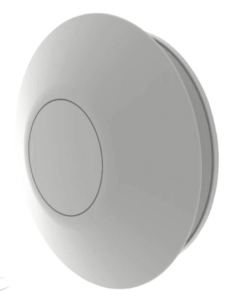
Why? These units can be installed like a traditional extract fan, but the fan speed can be adjusted and commissioned. Remember, where these are installed (eg. Bathrooms) DO NOT install trickle vents in that room, the intention is to draw air from other parts of the dwelling.
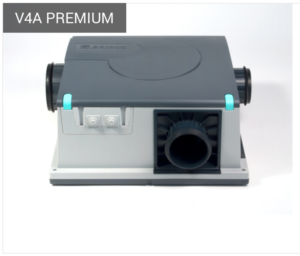
The next level up would be a CMEV system, the advantages are that it needs to be designed, often by the manufacturer/ supplier, so it offers comfort to the builder that a professional has considered the amount of ventilation required and designed a system to meet the new Part F. The fan unit is about the size of a microwave oven and is often installed in a loft space and continuously draws air from the wet rooms to provide sufficient ventilation for occupants.
We really like Aereco’s products, and the customer support is pretty decent too. The product is unique in that the fan speed maintains a constant pressure differential to outside and coupled with special trickle vents that automatically open and close depending on the relative humidity levels in the room. The main disadvantage is the extra over cost (but you are getting peace of mind which has value) and having to run ducts through the house.
https://www.aereco.co.uk/products/exhaust-fans-uk/v4a-premium/
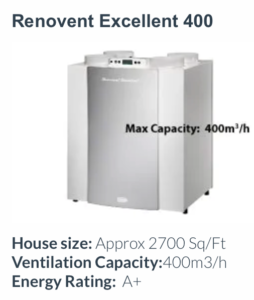
The gold standard for ventilation for homes is generally considered to be MVHR, in essence it is a large box with two fans inside. One fan extracts stale air from the wet rooms, whilst the second fan supplies fresh air to each habitable room (eg. Living room). The “HR” refers to heat recovery. Inside the box with the fans is a heat exchanger, which looks like a large honeycomb cell. Inside the cell is hundreds of parallel air pathways that exchange the warmth from the stale air on the way out with the fresh air on the way into the home. With this mechanism up to 85% of the heat can be recovered which increases the thermal efficiency of the home.
The disadvantages are the installation cost, the cost of exchanging filters (every 6-12 months) and having to run ducts to each room in the house. For low energy homes like Passivhaus homes, it is a mandatory requirement.
It is strongly recommended to use a competent designer and installer and not go for the cheapest unit you can find (they tend to be less efficient and noisy). We at New Build Air Testing can commission these units, which is a bit of a dark art.
We would recommend Zehnder or Brink as good quality units.
https://www.brinkhrv.com/MVHR-Machines
We work with a range of designers and manufacturers and can recommend both based on our experience. We can also work with self-builders to assist with installation and commissioning as required. Contact our office for more information.

